MOYEE IMPACT REPORT 2024
Dear Moyeesta, every 11 years or so, the sun's magnetic field completely flips. North and south poles switch places.
Moyee is in its 11th year, and we feel like we are in the midst of such a dramatic turn.
FACTORIES
OUR ECONOMIC IMPACT VALUABLE
JOBS AND A PROUD FUTURE
FOR THE YOUTH WITHOUT
THE NEED FOR
DEVELOPMENT AID.

LET'S FIX THE FUTURE!
(SNEAK PEEK 1 OF 3)
Yessss its ready, our latest impact report.
Before we officially launch it we will share 3 miniblogs about our three main impact pillars; Factories – Farmers – Forests or economic, social and environmental impact.
It’s called ‘Let’s Fix the Future!’ because a lot needs to be fixed. COVID-19 raised all sorts of havoc, but maybe most of all it unveiled society’s deep social riffs and the ever-rising inequality that is leading to ever-greater poverty, deforestation and climate change. One thing is clear: now more than ever we need better business models designed to solve these problems rather than continue to add to them.
With FairChain and Moyee, we’re building our company around Economic, Social and Environmental impact. How this is impacting us and, well, you, is in the report. We hope we can inspire you to make a difference, and please feel free to give us your feedback.
Thanks for supporting us over the years and….
Let’s Fix the Future together.
Cheers!
Guido & Team Moyee

JOBS SUPPORTED
By the end of 2020 we were supporting 61 value-adding jobs across our roasteries in Ethiopia and Kenya. That’s pretty impressive considering we began with 18 jobs in 2015. This number represents the jobs created by opening local roasteries and sustaining those jobs over the years.
BEANS EXPORTED
Last year we roasted a whopping 77,003 kg in Ethiopia and Kenya – that’s up from just 2,180 kg in Ethiopia in 2015. This number represents the number of kilo’s exported from Ethiopia and Kenya to elsewhere.
LEFT AT ORIGIN
By roasting locally, we leave behind more than 5 times as much value in country of origin compared to industry average. In practical terms this meant in 2020 that €575,000 of profits and income stayed in Ethiopia and Kenyan hands as against just €19,000 in 2015.
CUPS DRANK
If we measure FairChain awareness by cups, then in 2020 that awareness rings in at 13.6 million cups. This is the number of cups of FairChain coffee drank by our friends and fans. This is a radical increase from 3.7 million cups in 2015. We like to think we sparked a bona fide FairChain movement. Our ambition is to inspire consumers to make conscious decisions that have real impact.
LIMU, ETHIOPIA
With the Mizan Farm we’ve created a laboratory for the future of coffee that is fully under our control. In Limmu, however, we are working with hundreds of farmers and more than a thousand suppliers to introduce more sustainable farming methods that lead directly to more profitable farmers.
MIZAN, ETHIOPIA
Mizan Farm in southwest Ethiopia spans 247 hectares. It is here we we are experimenting with some of the most ambitious agroforestry projects on the planet.
KERICHO, KENYA
In the vibrant region of Kericho, Kenya, we are partnering closely with 151 smallholder farmers on the western shores of Lake Victoria.
MT ELGON, UGANDA
In 2020 we brought our FairChain revolution to Uganda by partnering with the Mt. Elgon Agroforestry Communitites Cooperative Enterprise (MEACCE), an established coop that comprises nearly 3,282 smallholder farmers focused on producing organic coffee.

ACHIEVEMENTS
#1 DOUBLE-DIGIT GROWTH
Our dynamic duo Killian and Shane are totally rocking it in Ireland. At the same time, we’ve also sent a few expedition vessels to the United Kingdom, Germany and France to touch base with a rising tide of FairChain fans. We sometimes refer to Moyee drinkers as Happy Activists, by which we mean friendly, open-minded individuals who, like us, see opportunity in healing the planet, (re)generative entrepreneurship and equality-driven business models. Oh, and they enjoy sipping a freakin’ great coffee that doesn’t destroy the planet.
These people are the reason we realized double-digit growth in 2019, which is pretty awesome. However, we didn’t have a whole lot of time to enjoy this growth. In the wake of Covid-19 pandemic, in the first half of 2020 we lost half our B2B revenues. At the same time, we gained extraordinary momentum on our B2C online sales – momentum we plan to ride on through to the end of this year and beyond. If the covid-19 virus has proven anything, it’s that many things in this world need fixing and that the FairChain philosophy goes a long way to fixing it. We expect to play an important role in the post-pandemic rebuild.


#2 KICKSTART KENYA
Moyee’s FairChain revolution is a global revolution. Our aim is to offer our fanbase stellar locally-roasted coffee from different places on the planet. Our customers want fair coffee with great flavor profiles. Our strategy is to respond to their demands. When we find a new coffee we think our fanbase will like, we first roast it in small batches at our Amsterdam HQ.
The roastery we have here is our playground where we test new flavors and, if needed, compensate for supply chain hiccups (which can be an issue when working in Africa). If our fans like the coffee and volumes grow, then we move production to the country of origin. This is precisely what is happening with our Kenyan Triple right now. After a successful introduction in small-batch form, we have moved the roasting and packaging of this lovely blend to Kenya.


FARMERS
OUR SOCIAL IMPACT A
LIVEABLE INCOME AS A FOUNDATION


PREMIUM PAID
We paid €1,065,000 in FairChain premium for our blends from Ethiopia and Kenya. On average we paid 300% more than the Fairtrade minimum price to our Ethiopian farmers. In Kenya we pay 20% on top of the farmer coop selling price set with other buyers.
FARMERS IN LIVING INCOME PROGRAM
If we measure FairChain awareness by cups, then in 2020 that awareness rings in at 13.6 million cups. This is the number of cups of FairChain coffee drank by our friends and fans. This is a radical increase from 3.7 million cups in 2015. We like to think we sparked a bona fide FairChain movement. Our ambition is to inspire consumers to make conscious decisions that have real impact.
LIVING INCOME DIFFERENTIAL
In 2022, we invested €233,000 in our LivEable Income program. ThIs brings the total to €1,575,000 since the program began.


ACHIEVEMENTS
#1 FROM 100 TO OVER 650 SMALLHOLDERS
When it comes to impact, size does matter. However, we see growth as a means, not an end. The more kilos you drink the more farmers we can support in our FairChain Farming program. These farmers are amongst the smallest and poorest in the region and have lived in poverty for generations.
Our Living Income Roadmap is their best – and often only – chance to turn their lives around. Our FairChain Farming program is instantly scalable and can accommodate up to 12,500 farmers. These are enough farmers to change the fate of an entire region and a significant upgrade for many, many farmers and their families.


#2 START OF THE 1 MILLION TREE REVOLUTION
Most of our farmers have less than one hectare of land and produce on average just 180 kg of green beans per hectare. It is absolutely essential then that we help them rejuvenate and/or replace their existing coffee trees in order to increase the quality of their beans and the size of their yields.
Planting trees plays an incredibly important role in our Living Income Roadmap. Last year we successfully supplied the first 35,000 seedlings to our farmers. We also invested heavily in two nurseries so that we can increase that number to 400,000 seedlings a year.
#3 FAIRCHAIN BLOCKCHAIN: DIGITALIZING FARMER PAYMENTS
In 2017, we were the first coffee company to put our farmer payments on the blockchain. We have continued to do so ever since.
Using the blockchain is not only a way to deliver on our brand promise or live up to radical transparency, it also gives us much better insights into our farmers’ earning capacity. This opens the door to farmer credit lines. It makes it possible to bank farmers, the vast majority of whom have been written off as unbankable.


#4 BANK ACCOUNTS, DIGITAL WALLETS, AND FEMALE EMPOWERMENT
Our FairChain colleagues spent the entire 2019 harvest in Limu, Ethiopia, opening some 371 new farmer bank accounts. 93 of those bank accounts were for women. The local bank couldn’t believe their eyes! Thanks to these bank accounts, farmers now have ID cards and digital wallets. Fast forward to now, and over 570 farmers have access to digital wallets.
Digital wallets are perfectly suited to farmer needs: they provide a reliable banking system that doesn’t require paper and gives them direct access to the bank. Another important advantage is that digital wallets empower women by giving them ownership over their own accounts. Finally, Moyee fans can contribute directly to farmers’ digital wallets without having to go through a middleman, including us!
#5 THE OPENING OF THE FIRST FAIRCHAIN WET MILL
We recently invested in the first FairChain wet mill, which we hope will lead to additional income for our farmers. Traditionally, wet mills are owned by wealthy farmers or co-ops who in turn keep most of the profits.
The profits generated by our FairChain wet mill will be shared with the farmer community. At the same time, our wet mill adds value by creating 118 seasonal jobs, the majority of which go to women.


FORESTS
MOYEE IS CO2 NEUTRAL!
WITH EVERY KILO OF MOYEE, YOU HELP IN THE FIGHT AGAINST CLIMATE CHANGE.

LET'S FIX THE FUTURE!
(SNEAK PEEK 3 OF 3)
In the future, we see much chaos, deep social cleavages, and ever-rising inequality leading to growing poverty, deforestation, and climate change. One thing is clear: now more than ever we need better business models designed to solve these problems rather than continue to add to them. With FairChain and Moyee, we’re building our company around Economic, Social and Environmental impact. The latest environmental impact update is in the CO2 performance ladder. We hope it inspires you to make a difference!
Thanks for supporting us over the years and….
Let’s Fix the Future together.
Cheers!
Guido & Team Moyee
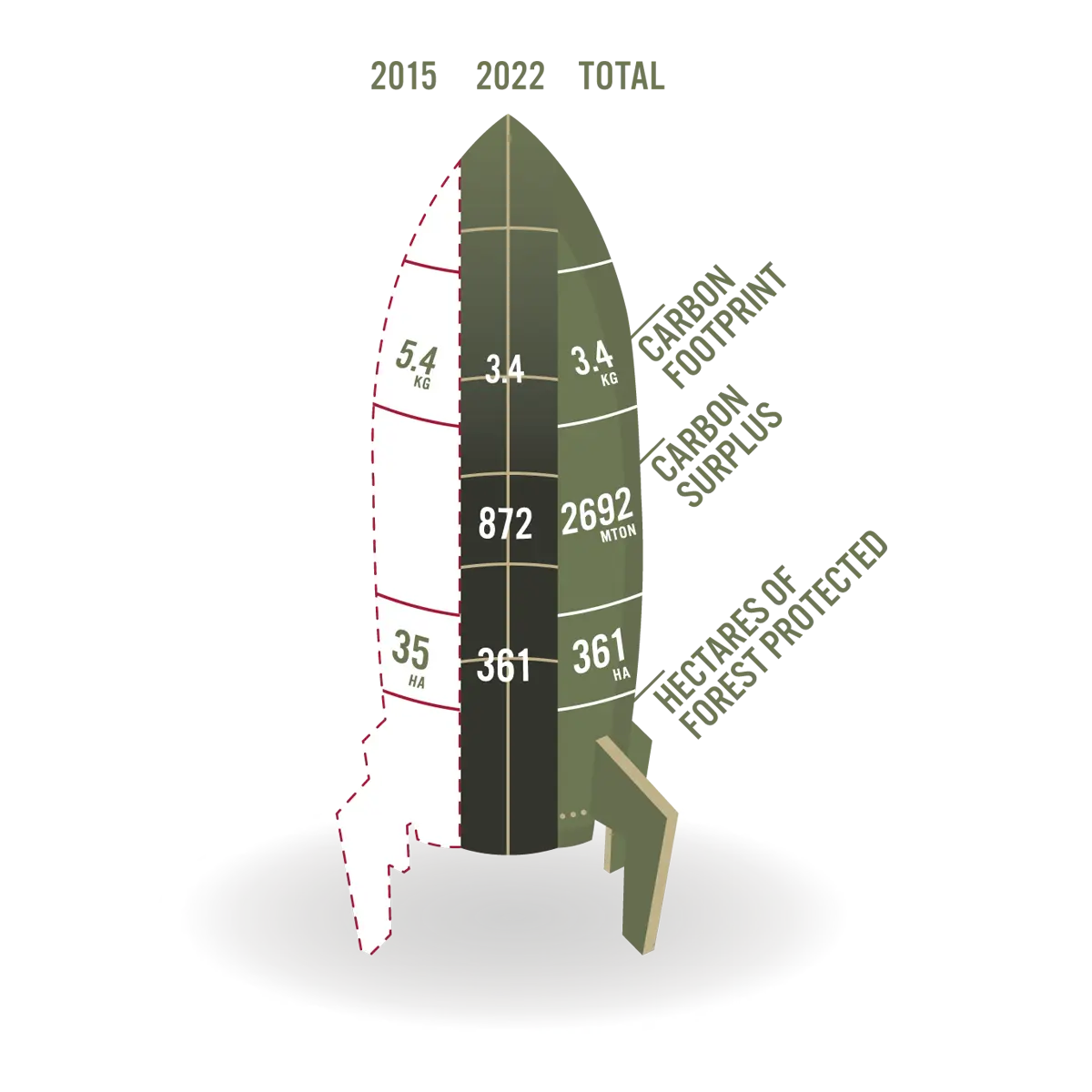
CARBON FOOTPRINT
Many coffees have a carbon footprint of 8 or 9kg of CO2 per 1kg bag of coffee, but Moyee Coffee’s is only 3.4kg. We still believe we can radically improve on this.
OF FOREST PROTECTED
Over the last few years Moyee has been working hard to redesign our business model to not only battle deforestation, but to win back the forests already lost, to enable our coffee farmers to earn a living income from their beans while rewarding and celebrating their agroforestry coffee production.
CARBON SURPLUS
Our chain enjoys 2,692 tons of carbon surplus, which means we absorb more CO2 than we emit. This surplus does not include the result of our own ambitious carbon deployment program on the farm in Mizan where we protect 361 hectares of natural forest plantings in Ethiopia. Soon we’ll be able to increase our surplus even more by planting 400,000 coffee trees, which will absorb a further 1,900 tons of CO2.


ACHIEVEMENTS
#1 FROM 100 TO OVER 650 SMALLHOLDERS
As we’ve discussed earlier in this report, poverty and deforestation go hand in hand. Which raises the question: can you tackle both problems simultaneously? This is precisely what we’re attempting to do with our 1 Million Tree Revolution, a campaign focused on planting 1 million new coffee trees in our farming communities.
In addition to combatting deforestation and absorbing an estimated 1.9kg CO2 from the air (equivalent to 3.800 return flights between Amsterdam and Barcelona), the new trees could also potentially double the income of our farmers on average. In 2020 we grew 400,000 seedlings in a local nursery, seedlings that are now ready to be planted with the help of a highly engaging consumer campaign.


#2 LOW-CARBON COFFEE KENYA
Unlike Ethiopian farmers, those in Kenya use loads of synthetic fertilizer. When we started our FairChain Farming program in Kenya changing this became our focus. Last year we trained the first 2,400 farmers and together with them built the first facility that produces bio-compost and bio-fertilizers at lower cost than that of existing alternatives.
Not only does this create jobs, but it also lowers the cost of production for farmers and increasees their income, enhances soil fertility, improves the health of coffee plants and restores biodiversity. ‘Intercropping’ is an important part of our strategy because it leads to greater farmer welfare and greater food security for their families. Profitable farmers are crucial to a prosperous planet.
#3 RAINFOREST ALLIANCE CERTIFICATION
We’ve always been pretty outspoken about our dislike of certification programs. It’s not personal, it’s just that they are expensive and not designed for companies like Moyee already operating on the frontline of climate change. We’d rather invest all that money in our farmers, especially because most of what we do goes above and beyond typical certification norms.
We made the decision to join the Rainforest Alliance because, quite simply, some of our largest clients demanded it. And fair is fair, the environmental demands of RFA certification are quite useful. Since joining, we’ve certified 580 farmers in our FairChain Farming program. That said, we still believe certification programs are expensive. But it’s easier to pay for certification than continuously explain all the reasons against it, so RFA certified we are.


#4 WAKING UP TO LAST MILE
With so much focus on our farmers, we’ve often neglected impact programs closer to home in Amsterdam. Why bother with last-mile circularity, rooftop solar panels and office waste management when our farmers are living in poverty? Our mission was originally focused entirely on the first mile.
However, last year we stepped up our game and initiated an ambitious last-mile sustainability program that includes reusable bamboo coffee mugs, compostable to-go cups, a coffee waste upcycling service for our customers and recyclable bags. We are late to the last mile, we admit it, but we’re doing our damnedest to make amends.
#5 TRUE COST PRICING IN COLOMBIA
We invited CSR Netherlands Moyee to join the Futureproof Coffee Collective, a group of forward-thinking coffee companies interested in researching True Cost Pricing.
We have begun experimenting with True Cost Pricing for our farmer project in Floridablanca, Colombia. This project gives us greater insight and hands-on knowledge into the True Price methodology not only in Colombia, but also our impact programs in Kenya and Ethiopia.


Read CO2 policy statement HERE
Read HERE more about the Performance Ladder and Stichting Klimaatvriendelijk Aanbesteden & Ondernemen (SKAO).
#6 CO2 PERFORMANCE LADDER
At Moyee Coffee, we are committed to making the world a better place, one cup at a time. That’s why we’re happy to share with you the CO2 Performance Ladder, a powerful tool to help organizations reduce their CO2 emissions. It offers not only a greener guide, but also a competitive advantage in environmentally friendly tenders.
The CO2 Performance Ladder consists of five levels of certification. Levels 1 to 3 focus on emissions within the organization and projects, while levels 4 and 5 also focus on the entire chain and sector. Each level requires that four core principles be met:
– Insight: Mapping energy consumption and carbon footprint.
– Reduction: Setting ambitious goals to reduce CO2 emissions.
– Transparency: Open and consistent communication on CO2 reduction policies. – Participation: Participation in sector-wide initiatives for joint carbon reduction.
At Moyee Coffee, we believe in doing what we say. With tools like the CO2 Performance Ladder, we are all contributing to a more sustainable future. Join us-together we can really make a difference.
